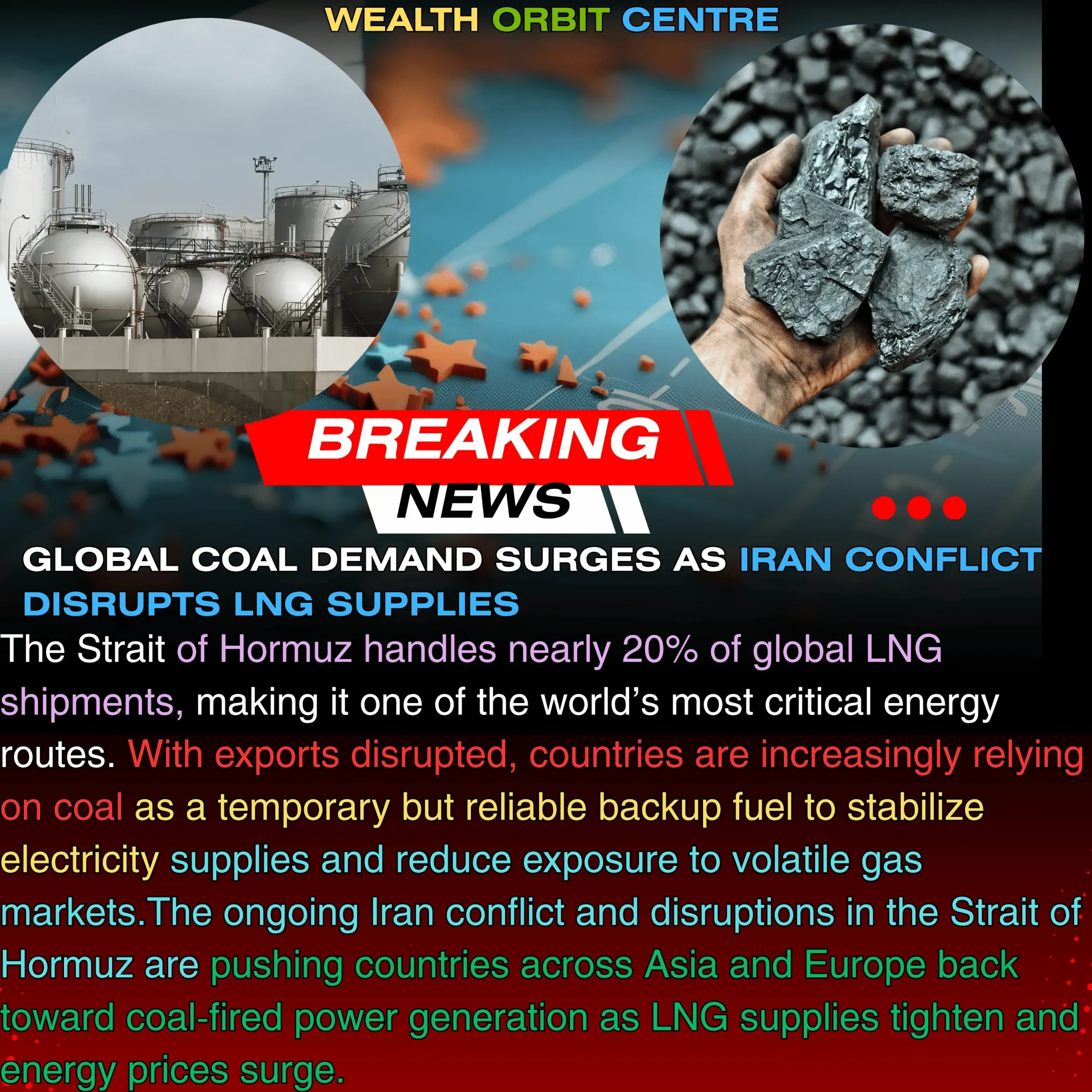
Countries Turn Back to Coal Amid Global Energy Supply Crisis
Countries across Asia and Europe are increasingly returning to coal-fired power generation after the Iran conflict severely disrupted global liquefied natural gas (LNG) supplies passing through the Strait of Hormuz. The crisis has triggered fears of prolonged energy shortages and forced governments to prioritize energy security over climate goals.
The Strait of Hormuz is one of the world’s most critical energy trade routes, handling nearly 20% of global LNG shipments. With the waterway effectively disrupted by the ongoing conflict, LNG exports to Asia have plunged, sending shockwaves through global energy markets and pushing nations back toward coal — one of the world’s most carbon-intensive fuel sources.
Coal Becomes Emergency Backup Fuel
As LNG prices rise and supplies tighten, coal is rapidly emerging as a temporary but reliable alternative for electricity generation. Several countries are restarting coal-fired power plants that had previously been shut down or placed on standby as part of climate transition efforts.
According to energy analysts, coal is now acting as a strategic “buffer fuel” because it is less exposed to geopolitical disruptions compared to LNG.
Tony Knutson, head of thermal coal markets at consulting firm Wood Mackenzie, said coal has become a hedge against uncertainty in global gas markets.
“Coal is a buffer fuel right now. It is independent of geopolitics relative to LNG. It is a hedge.”
He added that as long as the conflict continues and the Strait of Hormuz remains restricted, coal will likely continue filling the energy supply gap.
Coal Prices Rise as Demand Increases
The renewed demand for coal is already driving up prices globally. Spot coal prices at Australia’s Newcastle port — one of Asia’s key coal supply hubs — have surged 12% since the war began.
Benchmark coal prices briefly climbed above $140 per metric ton in mid-March, reaching their highest level since late 2024. Although prices remain well below the record highs seen after Russia’s invasion of Ukraine in 2022, analysts expect continued upward pressure if LNG shortages persist.
Taiwan Restarts Coal Power Plants
Taiwan has become one of the clearest examples of the global shift back toward coal. The island relies heavily on LNG for electricity generation, with around one-third of its imported gas normally sourced from Qatar.
Facing supply risks and rising fuel costs, Taiwan has restarted two coal-fired generators that had been idle for months as part of its transition away from coal energy.
State-owned utility Taipower cited instability in international energy markets and ongoing threats to LNG imports as major reasons for the move. Officials warned that emergency measures were necessary to stabilize electricity prices and protect households from energy shortages.
South Korea Boosts Coal Electricity Generation
South Korea has also sharply increased coal usage in recent months. According to electricity data platform Electricity Maps, coal-generated electricity jumped significantly compared with the previous year.
Coal power production reached 12.1 terawatt-hours in March and 10.7 terawatt-hours in April, representing year-over-year increases of 36% and 39% respectively.
The increase reflects broader concerns across Asia about LNG supply disruptions and the need to maintain stable electricity generation during periods of high demand.
India Orders Emergency Coal Output
India has issued emergency directives requiring power plants using imported coal to maximize electricity production ahead of what is expected to be an extremely hot summer season.
Electricity demand in India is forecast to surge due to increased air conditioner usage, raising fears about possible power shortages. Authorities in the state of Gujarat have already instructed utility company Tata Power to restart a coal-powered facility to strengthen electricity supply.
India remains one of the world’s largest coal consumers, and the latest energy crisis is reinforcing the country’s dependence on coal for energy security.
Thailand Reactivates Coal Units
Thailand has also restarted coal-fired units at one of its power plants in response to rising natural gas costs. Officials hope the move will help offset expensive LNG imports and stabilize domestic electricity prices.
The decision highlights how countries across Asia are increasingly relying on coal to manage short-term energy market volatility.
Europe Responds More Carefully
While Europe has not shifted back to coal as aggressively as Asia, several countries are reconsidering their coal strategies amid fears of prolonged LNG shortages.
Italy has placed coal plants on standby and warned they could be reactivated if the Middle East conflict deepens into a broader energy crisis. Natural gas currently accounts for roughly 40% of Italy’s energy supply, making the country particularly vulnerable to LNG disruptions.
The Italian government has already delayed plans to completely phase out coal-fired power plants until 2038.
Germany is also considering slowing the closure of some coal facilities. German Chancellor Friedrich Merz recently acknowledged that supply shortages could force the country to keep certain coal plants operational longer than originally planned.
LNG Supply Disruptions Hit Asia Hardest
Asia remains the region most affected by the Strait of Hormuz disruption. Nearly 90% of LNG exports passing through the waterway are normally destined for Asian markets.
Since the conflict began, LNG shipments through the strait have slowed dramatically. Only a handful of LNG carriers have managed to pass through the route, significantly reducing fuel availability across the region.
The last LNG cargo from Qatar bound for Asia reportedly left the Persian Gulf before the war escalated and arrived in China in late March.
Data from energy analytics firm Vortexa shows Asian LNG imports recently fell to their lowest levels in six years, matching demand conditions last seen during the peak of the Covid-19 pandemic.
Climate Goals Face New Challenges
The return to coal is raising major environmental concerns. Coal emits roughly twice as much carbon dioxide as natural gas, making it one of the largest contributors to global greenhouse gas emissions.
For years, many countries attempted to reduce coal consumption and transition toward cleaner fuels such as LNG and renewable energy. However, the latest geopolitical crisis is forcing governments to temporarily prioritize energy reliability and affordability over emissions reduction targets.
Analysts now believe the expected decline in global coal demand by the end of the decade could be delayed if LNG markets remain unstable.
Echoes of the 2022 Energy Crisis
The current shift back to coal strongly resembles the global energy crisis that followed Russia’s invasion of Ukraine in 2022. At that time, reduced natural gas supplies forced countries — especially in Europe — to increase coal consumption to prevent electricity shortages.
The difference today is that Asia is now at the center of the coal resurgence, largely because of its heavy dependence on LNG imports traveling through the Strait of Hormuz.
Will Coal Demand Continue Rising?
Energy analysts expect global demand for seaborne coal to increase this year instead of stabilizing as previously forecast.
Martin Senior, head of LNG pricing at Argus Media, noted that fuel-switching decisions are largely driven by economics.
“Burning coal instead of gas for most countries is mostly a question of price.”
Although countries like Japan and South Korea may still prefer cleaner gas generation for environmental reasons, persistently high LNG prices could force utilities to continue relying on coal in the near term.
Conclusion
The Iran conflict and the disruption of LNG shipments through the Strait of Hormuz are reshaping global energy markets and driving a renewed dependence on coal-fired power generation. Countries across Asia and parts of Europe are reviving coal plants to protect electricity supplies and shield consumers from soaring energy prices.
While the shift may prove temporary if LNG exports recover, the crisis has exposed the fragile balance between climate ambitions and energy security. For now, coal is once again becoming a critical part of the global energy system.